
INCEpTION - Welcome
Build annotated text corpora with your own annotation scheme, link every mention to a real knowledge base, and let a recommender that learns as you go do the repetitive part.
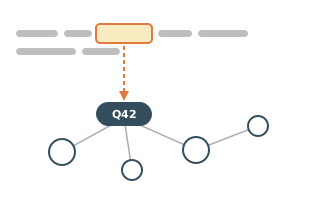
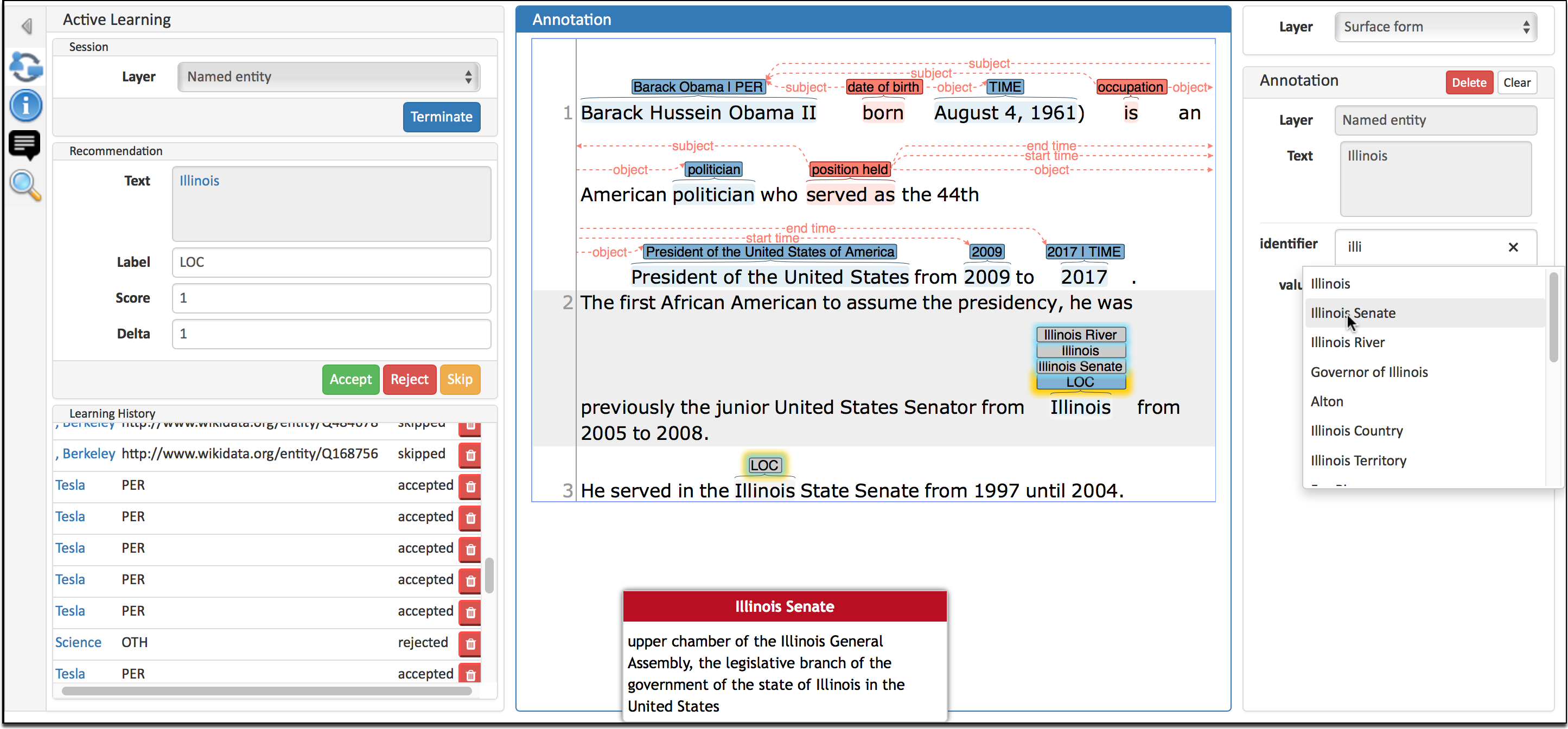
Load an ontology or thesaurus in RDF, OWL, OBO, SKOS or Turtle, or query a remote SPARQL endpoint live. Ready-made profiles cover Wikidata, SNOMED CT, the Gene Ontology, the Human Phenotype Ontology and the GND authority file. Annotators get ranked concept suggestions as they type.
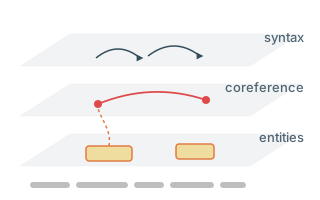
Entities, relations, coreference chains, syntax, frames and document labels, all over the same text and edited in one window. Typed features, with slots that link annotations together. Define the whole scheme in the browser.
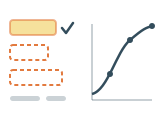
The recommender trains on what you have already annotated, so it gets better during the session. Active learning asks about the cases it is least sure of. Nothing enters your data until you accept it.
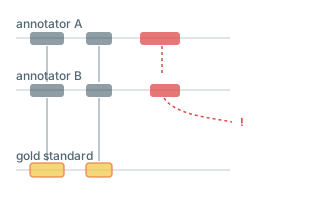
Have several people annotate the same documents, then merge them into a gold standard: agreements merge for you, so you only decide the real disagreements. Inter-annotator agreement is measured in the tool, and the Explorer charts what you actually collected.
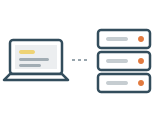
A desktop installer for one person on a laptop, or a server deployment for a whole institution — on your own hardware, inside your own network and security infrastructure, with your existing single sign-on.
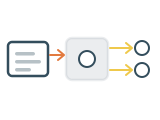
A REST API to create projects, load documents and pull annotations out, plus webhooks that notify your services when a document or project changes. Bring your own models as external recommenders. Annotation becomes a step in your pipeline, not a detour out of it.
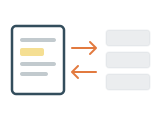
Import plain text, PDF, HTML and TEI. Export to UIMA CAS XMI or JSON with your custom layers intact, or to CoNLL-U for the standard layers — so the corpus you build stays usable elsewhere.
Developed by the UKP Lab at TU Darmstadt, and used across NLP, linguistics, digital humanities, the biomedical and clinical domain, the social sciences, education, history, law — and more.
If you use INCEpTION in scientific work or want to learn more about it, please have a look at
Klie, J.-C., Bugert, M., Boullosa, B., Eckart de Castilho, R. and Gurevych, I. (2018): The INCEpTION Platform: Machine-Assisted and Knowledge-Oriented Interactive Annotation. In Proceedings of System Demonstrations of the 27th International Conference on Computational Linguistics (COLING 2018), Santa Fe, New Mexico, USA (pdf) (bib) (flyer)
For publications on more specific aspects of the platform, have a look at our complete publications list.
INCEpTION is provided as open source under the Apache License v2.0.